

NZ Drug Trends and Roadside Testing — Personal Awareness on the Rise
Share This Post

New Zealand’s latest National Drugs in Wastewater Testing Programme results (Q3: July–September 2025) show shifting patterns in community drug use alongside growing public attention on impairment as roadside drug testing begins in Wellington.
Public Awareness and Personal Testing
The introduction of roadside drug testing in Wellington has increased public attention on drug impairment. Resultz NZ has, in the same period, recorded a marked lift in direct enquiries for DIY drug test kits from Wellington residents. This indicates heightened awareness translating into personal risk checks at the individual level.
“We’re hearing from more Wellingtoners who want to check themselves or family members before driving or working. It’s an encouraging sign that awareness is prompting practical, preventative steps.
“With roadside drug testing now underway, it will be interesting to see if upcoming wastewater cycles show any change in consumption patterns.”
– Kyly Coombes, Resultz Group NZ.
Against that backdrop of rising awareness, the Q3 wastewater results provide a clear, independent view of what’s actually being consumed across New Zealand. Here’s what the data shows.
Methamphetamine: Still New Zealand’s Most Harmful Drug

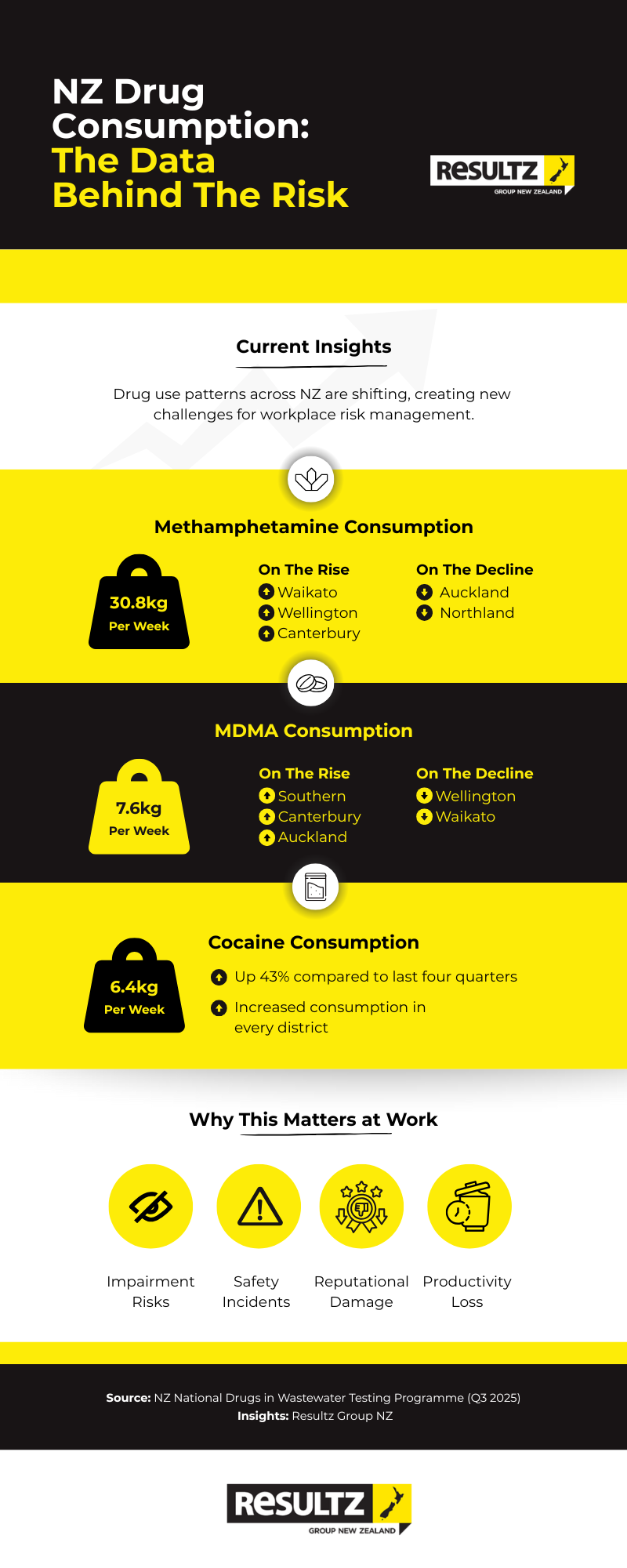
Methamphetamine continues to pose the greatest risk to communities and workplaces nationwide. Between July and September 2025, average consumption was 30.8 kg per week, a small lift on the previous quarter (29.1 kg).
District results are mixed. Waikato rose to 1,879 mg/day/1,000 people (vs 1,791 four-quarter average). Wellington nudged up to 868 (vs 816), and Canterbury to 679 (vs 635).
By contrast, Northland recorded a marked decrease to 1,613 (vs 1,934), and Tāmaki Makaurau/Auckland fell to 1,251 (vs 1,459).
MDMA: National Lift with Clear Regional Differences
MDMA consumption averaged 7.6 kg per week in Q3 2025, sitting 8% above the average of the last four quarters.
District results vary. Southern shows the most pronounced increase at 730 mg/day/1,000 (vs 478).
Other lifts appear in Canterbury (334 vs 301), Tāmaki Makaurau/Auckland (267 vs 247), Eastern (250 vs 217) and Central (242 vs 199).
Offsetting these are declines in Wellington (233 vs 266), Bay of Plenty (220 vs 249), Waikato (199 vs 230), Tasman (287 vs 304) and Northland (118 vs 123).
In short, Q3 shows a national increase driven largely by the Southern spike, with several northern and central districts trending lower than their recent averages.
Cocaine: Small Market, Clear Upward Shift
Cocaine consumption rose across the board in Q3 2025. Nationally, the programme records 6.4 kg per week, which is 43% higher than the average of the previous four quarters.
Every listed district sits above its recent average, with the sharpest lifts in Bay of Plenty (322 vs 166 mg/day/1,000), Southern (286 vs 132) and Tāmaki Makaurau/Auckland (325 vs 271).
Strong increases also appear in Wellington (212 vs 118) and Canterbury (175 vs 100), while Eastern (168 vs 82), Waikato (166 vs 105), Northland (133 vs 71), Central (71 vs 46) and Tasman (55 vs 27) all trend higher.
The pattern indicates a widespread upward shift in cocaine consumption this quarter, with particularly pronounced growth in Bay of Plenty, Southern, Auckland and Wellington.
Public Awareness and Personal Testing
The introduction of roadside drug testing in Wellington has increased public attention on drug impairment. Resultz NZ has, in the same period, recorded a marked lift in direct enquiries for DIY drug test kits from Wellington residents. This indicates heightened awareness translating into personal risk checks at the individual level.
“We’re hearing from more Wellingtoners who want to check themselves or family members before driving or working. It’s an encouraging sign that awareness is prompting practical, preventative steps. “With roadside drug testing now underway, it will be interesting to see if upcoming wastewater cycles show any change in consumption patterns.”
– Kyly Coombes, Resultz NZ
The Workplace Connection

According to Resultz Group, the wastewater findings highlight a clear reality – drug use remains an issue that inevitably reaches into New Zealand workplaces.
“Employers are on the front line of identifying and addressing drug-related risks,” says the spokesperson. “By maintaining robust testing policies, investing in education, and supporting rehabilitation where possible, businesses can protect both their teams and their reputation.”
With tens of millions of dollars in social harm occurring each week from methamphetamine, MDMA, and cocaine use, Resultz Group is urging New Zealand employers to maintain consistent, compliant workplace testing programmes that include education, training, and rehabilitation. A comprehensive, wraparound support system is vital to protecting both businesses and staff.